Review


r α4  (Alomone Labs)


Bioz Verified Symbol Alomone Labs is a verified supplier
Bioz Manufacturer Symbol Alomone Labs manufactures this product  

  • Logo
  • About
  • News
  • Press Release
  • Team
  • Advisors
  • Partners
  • Contact
  • Bioz Stars
  • Bioz vStars
  • 92

    Structured Review

    Alomone Labs r α4
    WB analysis for GABA A R β2, β3, and γ2 subunits in the primary SoCx. The data compare expression between control (NE) littermates and epileptic (E) stargazers. ( A – C ) Representative blots display tissue expression of GABA A R β2, β3, and γ2 subunits in the primary SoCx with β-actin as the loading control. Bar graphs represent the relative expression levels of GABA A R β2, β3, and γ2 subunits, respectively. Bar graphs show a lack of statistically significant change in whole-tissue primary SoCx expression levels for β2 (NE: 0.917 ± 0.091 [ n = 12], E: 0.678 ± 0.050 [ n = 10]; p = 0.093), β3 (NE: 1.000 ± 0.067 [ n = 12], E: 1.070 ± 0.109 [ n = 10]; p = 0.859), and γ2 (NE: 1.000 ± 0.159 [ n = 9], E: 0.946 ± 0.079 [ n = 7]; p = 0.900). The significance threshold was set at 0.05. ‘ns’ indicates no significant change found from analyses.
    R α4, supplied by Alomone Labs, used in various techniques. Bioz Stars score: 92/100, based on 7 PubMed citations. ZERO BIAS - scores, article reviews, protocol conditions and more
    https://www.bioz.com/result/r α4/product/Alomone Labs
    Average 92 stars, based on 7 article reviews
    r α4 - by Bioz Stars, 2026-06
    92/100 stars

    Images

    1) Product Images from "Altered GABA A Receptor Expression in the Primary Somatosensory Cortex of a Mouse Model of Genetic Absence Epilepsy"

    Article Title: Altered GABA A Receptor Expression in the Primary Somatosensory Cortex of a Mouse Model of Genetic Absence Epilepsy

    Journal: International Journal of Molecular Sciences

    doi: 10.3390/ijms232415685

    WB analysis for GABA A R β2, β3, and γ2 subunits in the primary SoCx. The data compare expression between control (NE) littermates and epileptic (E) stargazers. ( A – C ) Representative blots display tissue expression of GABA A R β2, β3, and γ2 subunits in the primary SoCx with β-actin as the loading control. Bar graphs represent the relative expression levels of GABA A R β2, β3, and γ2 subunits, respectively. Bar graphs show a lack of statistically significant change in whole-tissue primary SoCx expression levels for β2 (NE: 0.917 ± 0.091 [ n = 12], E: 0.678 ± 0.050 [ n = 10]; p = 0.093), β3 (NE: 1.000 ± 0.067 [ n = 12], E: 1.070 ± 0.109 [ n = 10]; p = 0.859), and γ2 (NE: 1.000 ± 0.159 [ n = 9], E: 0.946 ± 0.079 [ n = 7]; p = 0.900). The significance threshold was set at 0.05. ‘ns’ indicates no significant change found from analyses.
    Figure Legend Snippet: WB analysis for GABA A R β2, β3, and γ2 subunits in the primary SoCx. The data compare expression between control (NE) littermates and epileptic (E) stargazers. ( A – C ) Representative blots display tissue expression of GABA A R β2, β3, and γ2 subunits in the primary SoCx with β-actin as the loading control. Bar graphs represent the relative expression levels of GABA A R β2, β3, and γ2 subunits, respectively. Bar graphs show a lack of statistically significant change in whole-tissue primary SoCx expression levels for β2 (NE: 0.917 ± 0.091 [ n = 12], E: 0.678 ± 0.050 [ n = 10]; p = 0.093), β3 (NE: 1.000 ± 0.067 [ n = 12], E: 1.070 ± 0.109 [ n = 10]; p = 0.859), and γ2 (NE: 1.000 ± 0.159 [ n = 9], E: 0.946 ± 0.079 [ n = 7]; p = 0.900). The significance threshold was set at 0.05. ‘ns’ indicates no significant change found from analyses.

    Techniques Used: Expressing, Control

    WB analysis for the principal tonic GABA A R α4, α5, and δ subunits. Analysis compares the primary SoCx of control (NE) littermates and the epileptic (E) stargazers. ( A – C ) Representative blots display tissue expression of GABA A R α4, α5, and δ subunits in the primary SoCx with β-actin as the loading control. Bar graphs represent the relative expression levels of GABA A R α4, α5 and δ subunits, respectively. Bar graphs reveal a lack of statistically significant change in whole-tissue primary SoCx expression levels for GABA A R α4 (NE: 1.000 ± 0.063 [ n = 18], E: 1.117 ± 0.095 [ n = 15]; p = 0.325), α5 (NE: 1.000 ± 0.048 [ n = 23], E: 0.937 ± 0.083 [ n = 13]; p = 0.672), and δ (NE: 1.000 ± 0.041 [ n = 27], E: 0.899 ± 0.069 [ n = 23]; p = 0.215). The significance threshold was set at 0.05. ‘ns’ indicates no significant change found from analyses.
    Figure Legend Snippet: WB analysis for the principal tonic GABA A R α4, α5, and δ subunits. Analysis compares the primary SoCx of control (NE) littermates and the epileptic (E) stargazers. ( A – C ) Representative blots display tissue expression of GABA A R α4, α5, and δ subunits in the primary SoCx with β-actin as the loading control. Bar graphs represent the relative expression levels of GABA A R α4, α5 and δ subunits, respectively. Bar graphs reveal a lack of statistically significant change in whole-tissue primary SoCx expression levels for GABA A R α4 (NE: 1.000 ± 0.063 [ n = 18], E: 1.117 ± 0.095 [ n = 15]; p = 0.325), α5 (NE: 1.000 ± 0.048 [ n = 23], E: 0.937 ± 0.083 [ n = 13]; p = 0.672), and δ (NE: 1.000 ± 0.041 [ n = 27], E: 0.899 ± 0.069 [ n = 23]; p = 0.215). The significance threshold was set at 0.05. ‘ns’ indicates no significant change found from analyses.

    Techniques Used: Control, Expressing

    WB analyses of biochemically isolated fractions from primary SoCx for GABA A R α4, α5, and δ subunits. Subcellular fractions were isolated from the control (NE) littermates and epileptic epileptic (E) stargazers. ( A – D ) Biochemical fractionation analysis revealed no significant change in GABA A R α4 in all subcellular components from the primary SoCx of stargazers compared to their NE littermates: total lysate (NE: 1.000 ± 0.063 [ n = 9], E: 1.353 ± 0.227 [ n = 9]; p = 0.257), cytosol (NE: 1.000 ± 0.088 [ n = 14], E: 1.308 ± 0.223 [ n = 10]; p = 0.172), extra-synaptic (NE: 1.000 ± 0.051 [ n = 14], E: 0.789 ± 0.183 [ n = 9]; p = 0.516), and synaptic (NE: 1.000 ± 0.047 [ n = 14], E: 0.955 ± 0.122 [ n = 9]; p = 0.369). ( E – H ) GABA A R α5 analysis revealed no significant change in all subcellular components from the primary SoCx of stargazers compared to their control littermates: total lysate (NE: 1.000 ± 0.094 [ n = 10], E: 0.919 ± 0.102 [ n = 10]; p = 0.566), cytosol (NE: 1.000 ± 0.113 [ n = 14], E: 1.295 ± 0.362 [ n = 8]; p = 0.920), extra-synaptic (NE: 1.000 ± 0.068 [ n = 13], E: 1.324 ± 0.214 [ n = 9]; p = 0.431) and, synaptic (NE: 1.000 ± 0.075 [ n = 13], E: 1.190 ± 0.195 [ n = 9]; p = 0.744). ( I – L ) No statistically significant change was also seen for GABA A R δ subunit in all subcellular components from the primary SoCx of stargazers compared to their control littermates: total lysate (NE: 1.000 ± 0.071 [ n = 15], E: 1.088 ± 0.201 [ n = 9]; p = 0.815), cytosol (NE: 1.000 ± 0.083 [ n = 15], E: 0.831 ± 0.138 [ n = 9]; p = 0.379), extra-synaptic (NE: 1.000 ± 0.078 [ n = 15], E: 1.419 ± 0.241 [ n = 10]; p = 0.191), and synaptic (NE: 1.000 ± 0.053 [ n = 15], E: 1.092 ± 0.094 [ n = 9]; p = 0.263). The significance threshold was set at 0.05. ‘ns’ indicates no significant change found from analyses.
    Figure Legend Snippet: WB analyses of biochemically isolated fractions from primary SoCx for GABA A R α4, α5, and δ subunits. Subcellular fractions were isolated from the control (NE) littermates and epileptic epileptic (E) stargazers. ( A – D ) Biochemical fractionation analysis revealed no significant change in GABA A R α4 in all subcellular components from the primary SoCx of stargazers compared to their NE littermates: total lysate (NE: 1.000 ± 0.063 [ n = 9], E: 1.353 ± 0.227 [ n = 9]; p = 0.257), cytosol (NE: 1.000 ± 0.088 [ n = 14], E: 1.308 ± 0.223 [ n = 10]; p = 0.172), extra-synaptic (NE: 1.000 ± 0.051 [ n = 14], E: 0.789 ± 0.183 [ n = 9]; p = 0.516), and synaptic (NE: 1.000 ± 0.047 [ n = 14], E: 0.955 ± 0.122 [ n = 9]; p = 0.369). ( E – H ) GABA A R α5 analysis revealed no significant change in all subcellular components from the primary SoCx of stargazers compared to their control littermates: total lysate (NE: 1.000 ± 0.094 [ n = 10], E: 0.919 ± 0.102 [ n = 10]; p = 0.566), cytosol (NE: 1.000 ± 0.113 [ n = 14], E: 1.295 ± 0.362 [ n = 8]; p = 0.920), extra-synaptic (NE: 1.000 ± 0.068 [ n = 13], E: 1.324 ± 0.214 [ n = 9]; p = 0.431) and, synaptic (NE: 1.000 ± 0.075 [ n = 13], E: 1.190 ± 0.195 [ n = 9]; p = 0.744). ( I – L ) No statistically significant change was also seen for GABA A R δ subunit in all subcellular components from the primary SoCx of stargazers compared to their control littermates: total lysate (NE: 1.000 ± 0.071 [ n = 15], E: 1.088 ± 0.201 [ n = 9]; p = 0.815), cytosol (NE: 1.000 ± 0.083 [ n = 15], E: 0.831 ± 0.138 [ n = 9]; p = 0.379), extra-synaptic (NE: 1.000 ± 0.078 [ n = 15], E: 1.419 ± 0.241 [ n = 10]; p = 0.191), and synaptic (NE: 1.000 ± 0.053 [ n = 15], E: 1.092 ± 0.094 [ n = 9]; p = 0.263). The significance threshold was set at 0.05. ‘ns’ indicates no significant change found from analyses.

    Techniques Used: Isolation, Control, Fractionation


    Similar Products

    92
    Alomone Labs r α4
    WB analysis for GABA A R β2, β3, and γ2 subunits in the primary SoCx. The data compare expression between control (NE) littermates and epileptic (E) stargazers. ( A – C ) Representative blots display tissue expression of GABA A R β2, β3, and γ2 subunits in the primary SoCx with β-actin as the loading control. Bar graphs represent the relative expression levels of GABA A R β2, β3, and γ2 subunits, respectively. Bar graphs show a lack of statistically significant change in whole-tissue primary SoCx expression levels for β2 (NE: 0.917 ± 0.091 [ n = 12], E: 0.678 ± 0.050 [ n = 10]; p = 0.093), β3 (NE: 1.000 ± 0.067 [ n = 12], E: 1.070 ± 0.109 [ n = 10]; p = 0.859), and γ2 (NE: 1.000 ± 0.159 [ n = 9], E: 0.946 ± 0.079 [ n = 7]; p = 0.900). The significance threshold was set at 0.05. ‘ns’ indicates no significant change found from analyses.
    R α4, supplied by Alomone Labs, used in various techniques. Bioz Stars score: 92/100, based on 1 PubMed citations. ZERO BIAS - scores, article reviews, protocol conditions and more
    https://www.bioz.com/result/r α4/product/Alomone Labs
    Average 92 stars, based on 1 article reviews
    r α4 - by Bioz Stars, 2026-06
    92/100 stars
      Buy from Supplier

    88
    R&D Systems mouse monoclonal anti integrin α4 r d systems bba37 2b4
    WB analysis for GABA A R β2, β3, and γ2 subunits in the primary SoCx. The data compare expression between control (NE) littermates and epileptic (E) stargazers. ( A – C ) Representative blots display tissue expression of GABA A R β2, β3, and γ2 subunits in the primary SoCx with β-actin as the loading control. Bar graphs represent the relative expression levels of GABA A R β2, β3, and γ2 subunits, respectively. Bar graphs show a lack of statistically significant change in whole-tissue primary SoCx expression levels for β2 (NE: 0.917 ± 0.091 [ n = 12], E: 0.678 ± 0.050 [ n = 10]; p = 0.093), β3 (NE: 1.000 ± 0.067 [ n = 12], E: 1.070 ± 0.109 [ n = 10]; p = 0.859), and γ2 (NE: 1.000 ± 0.159 [ n = 9], E: 0.946 ± 0.079 [ n = 7]; p = 0.900). The significance threshold was set at 0.05. ‘ns’ indicates no significant change found from analyses.
    Mouse Monoclonal Anti Integrin α4 R D Systems Bba37 2b4, supplied by R&D Systems, used in various techniques. Bioz Stars score: 88/100, based on 1 PubMed citations. ZERO BIAS - scores, article reviews, protocol conditions and more
    https://www.bioz.com/result/mouse monoclonal anti integrin α4 r d systems bba37 2b4/product/R&D Systems
    Average 88 stars, based on 1 article reviews
    mouse monoclonal anti integrin α4 r d systems bba37 2b4 - by Bioz Stars, 2026-06
    88/100 stars
      Buy from Supplier

    90
    Santa Cruz Biotechnology primary antibody directed against the α4-subunit of gaba a receptor (gaba a r)
    Panels A and B: Food consumed daily in <t>4</t> groups of female (panel A) and male (panel B) animals from P38-43. The average daily food intake (kcal) relative to P40 was calculated as the food intake during each of the day divided by the total food intake of the animal on P40. Exercise alone reduces animal’s food intake in both females and males from P41 to P43. ABA females increased food intake on day 3 of food restriction (P43) compared to the first 24 hours of food restriction (P41), while no change of daily food intake was detected among ABA males during the three days of food restriction.
    Primary Antibody Directed Against The α4 Subunit Of Gaba A Receptor (Gaba A R), supplied by Santa Cruz Biotechnology, used in various techniques. Bioz Stars score: 90/100, based on 1 PubMed citations. ZERO BIAS - scores, article reviews, protocol conditions and more
    https://www.bioz.com/result/primary antibody directed against the α4-subunit of gaba a receptor (gaba a r)/product/Santa Cruz Biotechnology
    Average 90 stars, based on 1 article reviews
    primary antibody directed against the α4-subunit of gaba a receptor (gaba a r) - by Bioz Stars, 2026-06
    90/100 stars
      Buy from Supplier

    90
    Santa Cruz Biotechnology goat anti-α4 gaba a r subunit antibody santa cruz biotechnology #sc7355
    Panels A and B: Food consumed daily in <t>4</t> groups of female (panel A) and male (panel B) animals from P38-43. The average daily food intake (kcal) relative to P40 was calculated as the food intake during each of the day divided by the total food intake of the animal on P40. Exercise alone reduces animal’s food intake in both females and males from P41 to P43. ABA females increased food intake on day 3 of food restriction (P43) compared to the first 24 hours of food restriction (P41), while no change of daily food intake was detected among ABA males during the three days of food restriction.
    Goat Anti α4 Gaba A R Subunit Antibody Santa Cruz Biotechnology #Sc7355, supplied by Santa Cruz Biotechnology, used in various techniques. Bioz Stars score: 90/100, based on 1 PubMed citations. ZERO BIAS - scores, article reviews, protocol conditions and more
    https://www.bioz.com/result/goat anti-α4 gaba a r subunit antibody santa cruz biotechnology #sc7355/product/Santa Cruz Biotechnology
    Average 90 stars, based on 1 article reviews
    goat anti-α4 gaba a r subunit antibody santa cruz biotechnology #sc7355 - by Bioz Stars, 2026-06
    90/100 stars
      Buy from Supplier

    92
    Alomone Labs rabbit anti α4 gaba a r
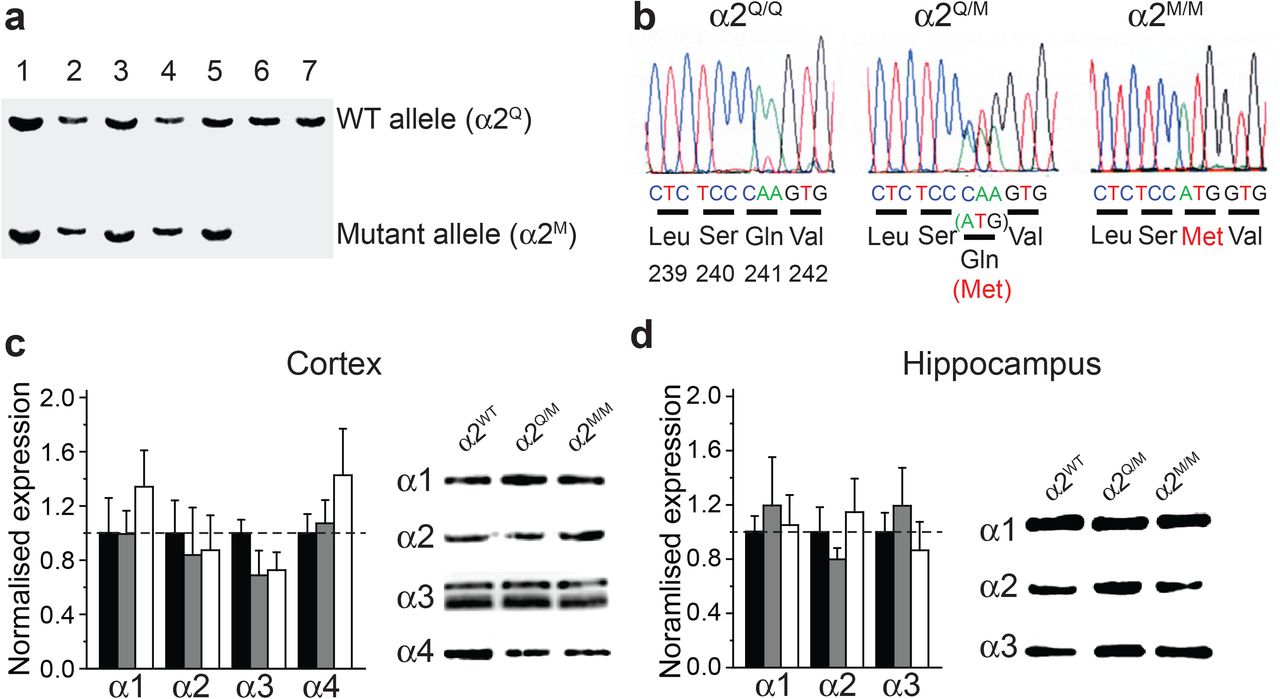
    (a) Southern blot screen of ES cell lines: the Q241M mutation silently introduces a novel restriction site – allowing a screen for restriction fragment length polymorphism. Lanes 1 - 5, heterozygous recombinants; lanes 6 - 7, wild-type littermate controls. (b) Verifying the point mutation by DNA sequencing. Exon 8 was PCR-amplified from mouse genomic DNA of wild-type (α2 Q/Q : left), α2 Q/M (middle) and α2 M/M (right) animals, then sequenced. Sequence data around the point mutation are shown. (c,d) <t>GABA</t> <t>A</t> <t>R</t> <t>α1-α4</t> subunit expression levels were determined by Western blotting total protein isolated from the cortex ( c ) and hippocampus ( d ). Left panels, quantitation of expression in α2 Q/M (grey) and α2 M/M (white) relative to wild-type (α2 Q/Q , black) brain samples. Right panels, representative Western blots from cortex and hippocampus for wild-type (WT), α2 Q/M and α2 M/M mice. Images show blots between 45 and 66 kDa markers. Loading controls with tubulin are omitted for clarity. Data are mean ± sem, one-way ANOVA, n = 6-9. There are no statistically significant differences between groups.
    Rabbit Anti α4 Gaba A R, supplied by Alomone Labs, used in various techniques. Bioz Stars score: 92/100, based on 1 PubMed citations. ZERO BIAS - scores, article reviews, protocol conditions and more
    https://www.bioz.com/result/rabbit anti α4 gaba a r/product/Alomone Labs
    Average 92 stars, based on 1 article reviews
    rabbit anti α4 gaba a r - by Bioz Stars, 2026-06
    92/100 stars
      Buy from Supplier

    90
    Santa Cruz Biotechnology primary antibody directed against the α4 subunit of gaba a receptor (gaba a r)
    Female mice were singly housed with access to a running wheel starting at noon at age P36. After 5 days of acclimation to the wheel (1st Baseline), their food access was restricted to two hours per day (from 7 - 9 PM) for 3 days (1st ABA). At the end of the 1st ABA, they were housed in fresh cages with ad libitum food access and no running wheel. Following 7 days of recovery, access to a running wheel was restored. Following <t>4</t> days of wheel access with ad libitum food access (2nd Baseline), the second induction of ABA (2nd ABA) started, on P55. Mice were divided into two groups on P56, i.e. the second day of food restriction or FR2. The two groups were counterbalanced in terms of running activity on FR1. One group received P4 in oil and the other received only oil. All mice were perfused at noon on P59, at the end of the 2nd ABA, after four days of food restriction.
    Primary Antibody Directed Against The α4 Subunit Of Gaba A Receptor (Gaba A R), supplied by Santa Cruz Biotechnology, used in various techniques. Bioz Stars score: 90/100, based on 1 PubMed citations. ZERO BIAS - scores, article reviews, protocol conditions and more
    https://www.bioz.com/result/primary antibody directed against the α4 subunit of gaba a receptor (gaba a r)/product/Santa Cruz Biotechnology
    Average 90 stars, based on 1 article reviews
    primary antibody directed against the α4 subunit of gaba a receptor (gaba a r) - by Bioz Stars, 2026-06
    90/100 stars
      Buy from Supplier

    92
    Alomone Labs anti-gaba(a) alpha4 receptor (extracellular) antibody
    Female mice were singly housed with access to a running wheel starting at noon at age P36. After 5 days of acclimation to the wheel (1st Baseline), their food access was restricted to two hours per day (from 7 - 9 PM) for 3 days (1st ABA). At the end of the 1st ABA, they were housed in fresh cages with ad libitum food access and no running wheel. Following 7 days of recovery, access to a running wheel was restored. Following <t>4</t> days of wheel access with ad libitum food access (2nd Baseline), the second induction of ABA (2nd ABA) started, on P55. Mice were divided into two groups on P56, i.e. the second day of food restriction or FR2. The two groups were counterbalanced in terms of running activity on FR1. One group received P4 in oil and the other received only oil. All mice were perfused at noon on P59, at the end of the 2nd ABA, after four days of food restriction.
    Anti Gaba(a) Alpha4 Receptor (Extracellular) Antibody, supplied by Alomone Labs, used in various techniques. Bioz Stars score: 92/100, based on 1 PubMed citations. ZERO BIAS - scores, article reviews, protocol conditions and more
    https://www.bioz.com/result/anti-gaba(a) alpha4 receptor (extracellular) antibody/product/Alomone Labs
    Average 92 stars, based on 1 article reviews
    anti-gaba(a) alpha4 receptor (extracellular) antibody - by Bioz Stars, 2026-06
    92/100 stars
      Buy from Supplier

    90
    Santa Cruz Biotechnology the primary antibody directed against the α4 subunit of gaba a receptor (gaba a r)
    Table 2
    The Primary Antibody Directed Against The α4 Subunit Of Gaba A Receptor (Gaba A R), supplied by Santa Cruz Biotechnology, used in various techniques. Bioz Stars score: 90/100, based on 1 PubMed citations. ZERO BIAS - scores, article reviews, protocol conditions and more
    https://www.bioz.com/result/the primary antibody directed against the α4 subunit of gaba a receptor (gaba a r)/product/Santa Cruz Biotechnology
    Average 90 stars, based on 1 article reviews
    the primary antibody directed against the α4 subunit of gaba a receptor (gaba a r) - by Bioz Stars, 2026-06
    90/100 stars
      Buy from Supplier

    90
    Santa Cruz Biotechnology primary antibody directed against α4 subunit gaba receptor (gaba r
    Table 2
    Primary Antibody Directed Against α4 Subunit Gaba Receptor (Gaba R, supplied by Santa Cruz Biotechnology, used in various techniques. Bioz Stars score: 90/100, based on 1 PubMed citations. ZERO BIAS - scores, article reviews, protocol conditions and more
    https://www.bioz.com/result/primary antibody directed against α4 subunit gaba receptor (gaba r/product/Santa Cruz Biotechnology
    Average 90 stars, based on 1 article reviews
    primary antibody directed against α4 subunit gaba receptor (gaba r - by Bioz Stars, 2026-06
    90/100 stars
      Buy from Supplier

    90
    Santa Cruz Biotechnology affinity-purified rabbit polyclonal antibodies for gaba a r α1, α2, α4, β2, and γ2 subunits
    Figure 2.
    Affinity Purified Rabbit Polyclonal Antibodies For Gaba A R α1, α2, α4, β2, And γ2 Subunits, supplied by Santa Cruz Biotechnology, used in various techniques. Bioz Stars score: 90/100, based on 1 PubMed citations. ZERO BIAS - scores, article reviews, protocol conditions and more
    https://www.bioz.com/result/affinity-purified rabbit polyclonal antibodies for gaba a r α1, α2, α4, β2, and γ2 subunits/product/Santa Cruz Biotechnology
    Average 90 stars, based on 1 article reviews
    affinity-purified rabbit polyclonal antibodies for gaba a r α1, α2, α4, β2, and γ2 subunits - by Bioz Stars, 2026-06
    90/100 stars
      Buy from Supplier

    Image Search Results


    WB analysis for GABA A R β2, β3, and γ2 subunits in the primary SoCx. The data compare expression between control (NE) littermates and epileptic (E) stargazers. ( A – C ) Representative blots display tissue expression of GABA A R β2, β3, and γ2 subunits in the primary SoCx with β-actin as the loading control. Bar graphs represent the relative expression levels of GABA A R β2, β3, and γ2 subunits, respectively. Bar graphs show a lack of statistically significant change in whole-tissue primary SoCx expression levels for β2 (NE: 0.917 ± 0.091 [ n = 12], E: 0.678 ± 0.050 [ n = 10]; p = 0.093), β3 (NE: 1.000 ± 0.067 [ n = 12], E: 1.070 ± 0.109 [ n = 10]; p = 0.859), and γ2 (NE: 1.000 ± 0.159 [ n = 9], E: 0.946 ± 0.079 [ n = 7]; p = 0.900). The significance threshold was set at 0.05. ‘ns’ indicates no significant change found from analyses.

    Journal: International Journal of Molecular Sciences

    Article Title: Altered GABA A Receptor Expression in the Primary Somatosensory Cortex of a Mouse Model of Genetic Absence Epilepsy

    doi: 10.3390/ijms232415685

    Figure Lengend Snippet: WB analysis for GABA A R β2, β3, and γ2 subunits in the primary SoCx. The data compare expression between control (NE) littermates and epileptic (E) stargazers. ( A – C ) Representative blots display tissue expression of GABA A R β2, β3, and γ2 subunits in the primary SoCx with β-actin as the loading control. Bar graphs represent the relative expression levels of GABA A R β2, β3, and γ2 subunits, respectively. Bar graphs show a lack of statistically significant change in whole-tissue primary SoCx expression levels for β2 (NE: 0.917 ± 0.091 [ n = 12], E: 0.678 ± 0.050 [ n = 10]; p = 0.093), β3 (NE: 1.000 ± 0.067 [ n = 12], E: 1.070 ± 0.109 [ n = 10]; p = 0.859), and γ2 (NE: 1.000 ± 0.159 [ n = 9], E: 0.946 ± 0.079 [ n = 7]; p = 0.900). The significance threshold was set at 0.05. ‘ns’ indicates no significant change found from analyses.

    Article Snippet: Membranes were probed using GABA A R α1 (1:500; AGA-001, Alomone, Jerusalem, Israel), GABA A R α3 (1:500; AGA-003, Alomone, Jerusalem, Israel), GABA A R α4 (1:200; AGA-008, Alomone, Jerusalem, Israel), GABA A R α5 (1:1000; AB9678, Sigma-Aldrich, St. Louis, MO, USA), GABA A R β2 (1:1000; ab8340, Abcam, Cambridge, UK), GABA A R β3 (1:1000; ab4046, Abcam, Cambridge, UK), GABA A R γ2 (1:200; AGA-005, Alomone, Jerusalem, Israel), and GABA A R δ (1:200; AGA-014, Alomone, Jerusalem, Israel) with β-actin (1:1000; ab8226, Abcam, Cambridge UK) used for normalization.

    Techniques: Expressing, Control

    WB analysis for the principal tonic GABA A R α4, α5, and δ subunits. Analysis compares the primary SoCx of control (NE) littermates and the epileptic (E) stargazers. ( A – C ) Representative blots display tissue expression of GABA A R α4, α5, and δ subunits in the primary SoCx with β-actin as the loading control. Bar graphs represent the relative expression levels of GABA A R α4, α5 and δ subunits, respectively. Bar graphs reveal a lack of statistically significant change in whole-tissue primary SoCx expression levels for GABA A R α4 (NE: 1.000 ± 0.063 [ n = 18], E: 1.117 ± 0.095 [ n = 15]; p = 0.325), α5 (NE: 1.000 ± 0.048 [ n = 23], E: 0.937 ± 0.083 [ n = 13]; p = 0.672), and δ (NE: 1.000 ± 0.041 [ n = 27], E: 0.899 ± 0.069 [ n = 23]; p = 0.215). The significance threshold was set at 0.05. ‘ns’ indicates no significant change found from analyses.

    Journal: International Journal of Molecular Sciences

    Article Title: Altered GABA A Receptor Expression in the Primary Somatosensory Cortex of a Mouse Model of Genetic Absence Epilepsy

    doi: 10.3390/ijms232415685

    Figure Lengend Snippet: WB analysis for the principal tonic GABA A R α4, α5, and δ subunits. Analysis compares the primary SoCx of control (NE) littermates and the epileptic (E) stargazers. ( A – C ) Representative blots display tissue expression of GABA A R α4, α5, and δ subunits in the primary SoCx with β-actin as the loading control. Bar graphs represent the relative expression levels of GABA A R α4, α5 and δ subunits, respectively. Bar graphs reveal a lack of statistically significant change in whole-tissue primary SoCx expression levels for GABA A R α4 (NE: 1.000 ± 0.063 [ n = 18], E: 1.117 ± 0.095 [ n = 15]; p = 0.325), α5 (NE: 1.000 ± 0.048 [ n = 23], E: 0.937 ± 0.083 [ n = 13]; p = 0.672), and δ (NE: 1.000 ± 0.041 [ n = 27], E: 0.899 ± 0.069 [ n = 23]; p = 0.215). The significance threshold was set at 0.05. ‘ns’ indicates no significant change found from analyses.

    Article Snippet: Membranes were probed using GABA A R α1 (1:500; AGA-001, Alomone, Jerusalem, Israel), GABA A R α3 (1:500; AGA-003, Alomone, Jerusalem, Israel), GABA A R α4 (1:200; AGA-008, Alomone, Jerusalem, Israel), GABA A R α5 (1:1000; AB9678, Sigma-Aldrich, St. Louis, MO, USA), GABA A R β2 (1:1000; ab8340, Abcam, Cambridge, UK), GABA A R β3 (1:1000; ab4046, Abcam, Cambridge, UK), GABA A R γ2 (1:200; AGA-005, Alomone, Jerusalem, Israel), and GABA A R δ (1:200; AGA-014, Alomone, Jerusalem, Israel) with β-actin (1:1000; ab8226, Abcam, Cambridge UK) used for normalization.

    Techniques: Control, Expressing

    WB analyses of biochemically isolated fractions from primary SoCx for GABA A R α4, α5, and δ subunits. Subcellular fractions were isolated from the control (NE) littermates and epileptic epileptic (E) stargazers. ( A – D ) Biochemical fractionation analysis revealed no significant change in GABA A R α4 in all subcellular components from the primary SoCx of stargazers compared to their NE littermates: total lysate (NE: 1.000 ± 0.063 [ n = 9], E: 1.353 ± 0.227 [ n = 9]; p = 0.257), cytosol (NE: 1.000 ± 0.088 [ n = 14], E: 1.308 ± 0.223 [ n = 10]; p = 0.172), extra-synaptic (NE: 1.000 ± 0.051 [ n = 14], E: 0.789 ± 0.183 [ n = 9]; p = 0.516), and synaptic (NE: 1.000 ± 0.047 [ n = 14], E: 0.955 ± 0.122 [ n = 9]; p = 0.369). ( E – H ) GABA A R α5 analysis revealed no significant change in all subcellular components from the primary SoCx of stargazers compared to their control littermates: total lysate (NE: 1.000 ± 0.094 [ n = 10], E: 0.919 ± 0.102 [ n = 10]; p = 0.566), cytosol (NE: 1.000 ± 0.113 [ n = 14], E: 1.295 ± 0.362 [ n = 8]; p = 0.920), extra-synaptic (NE: 1.000 ± 0.068 [ n = 13], E: 1.324 ± 0.214 [ n = 9]; p = 0.431) and, synaptic (NE: 1.000 ± 0.075 [ n = 13], E: 1.190 ± 0.195 [ n = 9]; p = 0.744). ( I – L ) No statistically significant change was also seen for GABA A R δ subunit in all subcellular components from the primary SoCx of stargazers compared to their control littermates: total lysate (NE: 1.000 ± 0.071 [ n = 15], E: 1.088 ± 0.201 [ n = 9]; p = 0.815), cytosol (NE: 1.000 ± 0.083 [ n = 15], E: 0.831 ± 0.138 [ n = 9]; p = 0.379), extra-synaptic (NE: 1.000 ± 0.078 [ n = 15], E: 1.419 ± 0.241 [ n = 10]; p = 0.191), and synaptic (NE: 1.000 ± 0.053 [ n = 15], E: 1.092 ± 0.094 [ n = 9]; p = 0.263). The significance threshold was set at 0.05. ‘ns’ indicates no significant change found from analyses.

    Journal: International Journal of Molecular Sciences

    Article Title: Altered GABA A Receptor Expression in the Primary Somatosensory Cortex of a Mouse Model of Genetic Absence Epilepsy

    doi: 10.3390/ijms232415685

    Figure Lengend Snippet: WB analyses of biochemically isolated fractions from primary SoCx for GABA A R α4, α5, and δ subunits. Subcellular fractions were isolated from the control (NE) littermates and epileptic epileptic (E) stargazers. ( A – D ) Biochemical fractionation analysis revealed no significant change in GABA A R α4 in all subcellular components from the primary SoCx of stargazers compared to their NE littermates: total lysate (NE: 1.000 ± 0.063 [ n = 9], E: 1.353 ± 0.227 [ n = 9]; p = 0.257), cytosol (NE: 1.000 ± 0.088 [ n = 14], E: 1.308 ± 0.223 [ n = 10]; p = 0.172), extra-synaptic (NE: 1.000 ± 0.051 [ n = 14], E: 0.789 ± 0.183 [ n = 9]; p = 0.516), and synaptic (NE: 1.000 ± 0.047 [ n = 14], E: 0.955 ± 0.122 [ n = 9]; p = 0.369). ( E – H ) GABA A R α5 analysis revealed no significant change in all subcellular components from the primary SoCx of stargazers compared to their control littermates: total lysate (NE: 1.000 ± 0.094 [ n = 10], E: 0.919 ± 0.102 [ n = 10]; p = 0.566), cytosol (NE: 1.000 ± 0.113 [ n = 14], E: 1.295 ± 0.362 [ n = 8]; p = 0.920), extra-synaptic (NE: 1.000 ± 0.068 [ n = 13], E: 1.324 ± 0.214 [ n = 9]; p = 0.431) and, synaptic (NE: 1.000 ± 0.075 [ n = 13], E: 1.190 ± 0.195 [ n = 9]; p = 0.744). ( I – L ) No statistically significant change was also seen for GABA A R δ subunit in all subcellular components from the primary SoCx of stargazers compared to their control littermates: total lysate (NE: 1.000 ± 0.071 [ n = 15], E: 1.088 ± 0.201 [ n = 9]; p = 0.815), cytosol (NE: 1.000 ± 0.083 [ n = 15], E: 0.831 ± 0.138 [ n = 9]; p = 0.379), extra-synaptic (NE: 1.000 ± 0.078 [ n = 15], E: 1.419 ± 0.241 [ n = 10]; p = 0.191), and synaptic (NE: 1.000 ± 0.053 [ n = 15], E: 1.092 ± 0.094 [ n = 9]; p = 0.263). The significance threshold was set at 0.05. ‘ns’ indicates no significant change found from analyses.

    Article Snippet: Membranes were probed using GABA A R α1 (1:500; AGA-001, Alomone, Jerusalem, Israel), GABA A R α3 (1:500; AGA-003, Alomone, Jerusalem, Israel), GABA A R α4 (1:200; AGA-008, Alomone, Jerusalem, Israel), GABA A R α5 (1:1000; AB9678, Sigma-Aldrich, St. Louis, MO, USA), GABA A R β2 (1:1000; ab8340, Abcam, Cambridge, UK), GABA A R β3 (1:1000; ab4046, Abcam, Cambridge, UK), GABA A R γ2 (1:200; AGA-005, Alomone, Jerusalem, Israel), and GABA A R δ (1:200; AGA-014, Alomone, Jerusalem, Israel) with β-actin (1:1000; ab8226, Abcam, Cambridge UK) used for normalization.

    Techniques: Isolation, Control, Fractionation

    Panels A and B: Food consumed daily in 4 groups of female (panel A) and male (panel B) animals from P38-43. The average daily food intake (kcal) relative to P40 was calculated as the food intake during each of the day divided by the total food intake of the animal on P40. Exercise alone reduces animal’s food intake in both females and males from P41 to P43. ABA females increased food intake on day 3 of food restriction (P43) compared to the first 24 hours of food restriction (P41), while no change of daily food intake was detected among ABA males during the three days of food restriction.

    Journal: Molecular and cellular neurosciences

    Article Title: α4-GABA A receptors of hippocampal pyramidal neurons are associated with resilience against activity-based anorexia for adolescent female mice but not for males

    doi: 10.1016/j.mcn.2018.04.008

    Figure Lengend Snippet: Panels A and B: Food consumed daily in 4 groups of female (panel A) and male (panel B) animals from P38-43. The average daily food intake (kcal) relative to P40 was calculated as the food intake during each of the day divided by the total food intake of the animal on P40. Exercise alone reduces animal’s food intake in both females and males from P41 to P43. ABA females increased food intake on day 3 of food restriction (P43) compared to the first 24 hours of food restriction (P41), while no change of daily food intake was detected among ABA males during the three days of food restriction.

    Article Snippet: 2.3.2 α4-immunoreactivity/Silver-intensified Gold Tissue Processing The primary antibody directed against the α4-subunit of GABA A receptor (GABA A R) was obtained from Santa Cruz Biotechnology (catalog #SC7355, lot J1912, Antibody Registry #AB_640770, RRID:AB_640770).

    Techniques:

    Panel A: A schematic of weight changes measured in relation to FAA. Panel B: For both female ABA and EX groups, the initial weight change from 1–7 pm on P41 are not correlated with the wheel activities during 1–7 pm on P42. Panel C: The weight changes within the initial 6 hr of food restriction (1–7 pm) correlates positively with the food anticipatory activity (1–7 pm) of ABA males on the second day of food restriction (FR2), but not for EX males on the corresponding day. Panel D: For both female ABA and EX groups, weight changes from P41-42 (7–7 pm) are not correlated the wheel activities during 1–7 pm on P43 (FAA on FR3). Panel E: Weight changes from P41-42 (7–7 pm) correlate positively with the food anticipatory activity (1–7 pm) of ABA males on the third day of food restriction (FAA on FR3), but not for EX males on the corresponding day. Regression lines indicate a significant correlation with p < .05. Dash regression lines indicate a marginal significant correlation with p = .057. Grey arrows indicate the mean value of each group.

    Journal: Molecular and cellular neurosciences

    Article Title: α4-GABA A receptors of hippocampal pyramidal neurons are associated with resilience against activity-based anorexia for adolescent female mice but not for males

    doi: 10.1016/j.mcn.2018.04.008

    Figure Lengend Snippet: Panel A: A schematic of weight changes measured in relation to FAA. Panel B: For both female ABA and EX groups, the initial weight change from 1–7 pm on P41 are not correlated with the wheel activities during 1–7 pm on P42. Panel C: The weight changes within the initial 6 hr of food restriction (1–7 pm) correlates positively with the food anticipatory activity (1–7 pm) of ABA males on the second day of food restriction (FR2), but not for EX males on the corresponding day. Panel D: For both female ABA and EX groups, weight changes from P41-42 (7–7 pm) are not correlated the wheel activities during 1–7 pm on P43 (FAA on FR3). Panel E: Weight changes from P41-42 (7–7 pm) correlate positively with the food anticipatory activity (1–7 pm) of ABA males on the third day of food restriction (FAA on FR3), but not for EX males on the corresponding day. Regression lines indicate a significant correlation with p < .05. Dash regression lines indicate a marginal significant correlation with p = .057. Grey arrows indicate the mean value of each group.

    Article Snippet: 2.3.2 α4-immunoreactivity/Silver-intensified Gold Tissue Processing The primary antibody directed against the α4-subunit of GABA A receptor (GABA A R) was obtained from Santa Cruz Biotechnology (catalog #SC7355, lot J1912, Antibody Registry #AB_640770, RRID:AB_640770).

    Techniques: Activity Assay

    Panels A–B, D–F: The electron micrographs show the range of subcellular locations where a4-immunoreactivity can be found. α4-subunit immunoreactivity was detected by the presence of SIG (silver-intensified gold) labels, which occurred on the plasma membrane (black short arrows) and intracellularly (white arrows) within dendritic shafts (Panels A, B) and spines (Panels D, E, F). T=terminal; Sp = dendritic spine. Plasmalemmal SIGs on dendritic shafts are near terminals forming symmetric, presumably inhibitory, synapses. Synapses associated with dendritic spines are asymmetric, based on the presence of thick postsynaptic densities, and presumably excitatory. These micrographs were taken from tissue of a CON female (Panel A), a CON male (Panel B), and females that underwent ABA (Panels D, E, F). Asterisks in panel A indicate the surface-most regions of vibratome sections, where transitions to no-tissue zones are apparent. Calibration bar equals 1 μm for panels A, D, E and F and equals 640 nm for panel B. Panel C: Group comparison of the density of α4-subunit immunoreactivity at dendritic shafts. ABA did not evoke a statistically significant difference from the CON in the plasmalemmal (upper panel), intracellular (middle panel), or total (plasmalemmal plus intracellular) labeling (lower panel) for females or males. Panel G: Group comparison of α4-subunit immunoreactivity at the plasma membrane of dendritic spines, at intracellular sites of dendritic spines, and generally within dendritic spines (plasmalemmal plus intracellular). ABA did not evoke a statistically significant difference from CONs in membranous labeling (upper panel) of either sex. For females, α4-subunit immunoreactivity was significantly increased at intracellular sites of dendritic spines (middle panel) and generally in association with dendritic spines (plasma membrane plus intracellular components) (lower panel), relative to CON tissue. Such a difference was not observed for the ABA males. * indicates p < .05.

    Journal: Molecular and cellular neurosciences

    Article Title: α4-GABA A receptors of hippocampal pyramidal neurons are associated with resilience against activity-based anorexia for adolescent female mice but not for males

    doi: 10.1016/j.mcn.2018.04.008

    Figure Lengend Snippet: Panels A–B, D–F: The electron micrographs show the range of subcellular locations where a4-immunoreactivity can be found. α4-subunit immunoreactivity was detected by the presence of SIG (silver-intensified gold) labels, which occurred on the plasma membrane (black short arrows) and intracellularly (white arrows) within dendritic shafts (Panels A, B) and spines (Panels D, E, F). T=terminal; Sp = dendritic spine. Plasmalemmal SIGs on dendritic shafts are near terminals forming symmetric, presumably inhibitory, synapses. Synapses associated with dendritic spines are asymmetric, based on the presence of thick postsynaptic densities, and presumably excitatory. These micrographs were taken from tissue of a CON female (Panel A), a CON male (Panel B), and females that underwent ABA (Panels D, E, F). Asterisks in panel A indicate the surface-most regions of vibratome sections, where transitions to no-tissue zones are apparent. Calibration bar equals 1 μm for panels A, D, E and F and equals 640 nm for panel B. Panel C: Group comparison of the density of α4-subunit immunoreactivity at dendritic shafts. ABA did not evoke a statistically significant difference from the CON in the plasmalemmal (upper panel), intracellular (middle panel), or total (plasmalemmal plus intracellular) labeling (lower panel) for females or males. Panel G: Group comparison of α4-subunit immunoreactivity at the plasma membrane of dendritic spines, at intracellular sites of dendritic spines, and generally within dendritic spines (plasmalemmal plus intracellular). ABA did not evoke a statistically significant difference from CONs in membranous labeling (upper panel) of either sex. For females, α4-subunit immunoreactivity was significantly increased at intracellular sites of dendritic spines (middle panel) and generally in association with dendritic spines (plasma membrane plus intracellular components) (lower panel), relative to CON tissue. Such a difference was not observed for the ABA males. * indicates p < .05.

    Article Snippet: 2.3.2 α4-immunoreactivity/Silver-intensified Gold Tissue Processing The primary antibody directed against the α4-subunit of GABA A receptor (GABA A R) was obtained from Santa Cruz Biotechnology (catalog #SC7355, lot J1912, Antibody Registry #AB_640770, RRID:AB_640770).

    Techniques: Clinical Proteomics, Membrane, Comparison, Labeling

    Panels A and B: Food restriction (FR)-induced increase in wheel running activity was calculated as the average running activity during the three food-restricted days minus the average wheel running activity during the three days preceding food restriction. This value is negatively correlated with the density of α4-subunits at the plasma membrane of ABA females (panel A), but not of ABA males (panel E). Females with the highest levels of α4-subunit immunoreactivity showed the least amount of food restriction-induced increase in wheel running. Panels B – D: For ABA females, the average running activity during the three food-restricted days (panel B), the average running activity during the last two day of food restriction (FR2 + FR3, panel C), and the wheel running activity on the last day (FR3, panel D), are negatively correlated with the density of α4-subunits at the plasma membrane. Females with the highest levels of α4-subunit immunoreactivity showed the least amount of wheel running activity during these food-restricted periods (panels B, C and D). Panels F–H: On the other hand, α4-subunit immunoreactivity of ABA males did not correlate with their wheel running during the three food-restricted days (panels F). Males with the highest levels of α4-subunit immunoreactivity showed the highest amount of wheel running activity during the last two days of food restriction (panel G–H). Regression lines indicate a significant correlation with p < .05. Dashed regression lines indicate a marginal significant correlation with p ≦ .1.

    Journal: Molecular and cellular neurosciences

    Article Title: α4-GABA A receptors of hippocampal pyramidal neurons are associated with resilience against activity-based anorexia for adolescent female mice but not for males

    doi: 10.1016/j.mcn.2018.04.008

    Figure Lengend Snippet: Panels A and B: Food restriction (FR)-induced increase in wheel running activity was calculated as the average running activity during the three food-restricted days minus the average wheel running activity during the three days preceding food restriction. This value is negatively correlated with the density of α4-subunits at the plasma membrane of ABA females (panel A), but not of ABA males (panel E). Females with the highest levels of α4-subunit immunoreactivity showed the least amount of food restriction-induced increase in wheel running. Panels B – D: For ABA females, the average running activity during the three food-restricted days (panel B), the average running activity during the last two day of food restriction (FR2 + FR3, panel C), and the wheel running activity on the last day (FR3, panel D), are negatively correlated with the density of α4-subunits at the plasma membrane. Females with the highest levels of α4-subunit immunoreactivity showed the least amount of wheel running activity during these food-restricted periods (panels B, C and D). Panels F–H: On the other hand, α4-subunit immunoreactivity of ABA males did not correlate with their wheel running during the three food-restricted days (panels F). Males with the highest levels of α4-subunit immunoreactivity showed the highest amount of wheel running activity during the last two days of food restriction (panel G–H). Regression lines indicate a significant correlation with p < .05. Dashed regression lines indicate a marginal significant correlation with p ≦ .1.

    Article Snippet: 2.3.2 α4-immunoreactivity/Silver-intensified Gold Tissue Processing The primary antibody directed against the α4-subunit of GABA A receptor (GABA A R) was obtained from Santa Cruz Biotechnology (catalog #SC7355, lot J1912, Antibody Registry #AB_640770, RRID:AB_640770).

    Techniques: Activity Assay, Clinical Proteomics, Membrane

    Panels A and E: Body weight loss after three days of food restriction (FR) is negatively correlated with α4-subunit labeling at the plasma membrane of ABA females (panel A) but not of ABA males (panel E). Females with the highest levels of α4-subunit immunoreactivity show the least amount of weight loss during the food-restricted period. Panels B and F: Wheel running activity during the first day of food restriction is negatively correlated with α4-subunit labeling at the plasma membrane of ABA females (panel B) but not of ABA males (panel F). Females with the highest levels of α4-subunit immunoreactivity show the least amount of wheel running activity during the first day of food restriction. Panels C–D, G–H: Female and male hippocampi differ in the subcellular compartment exhibiting correlation between α4-subunit immunoreactivity and wheel running activity. Food restriction-induced increase in wheel running activity during the food access period was calculated by the running activity during the food-access period on P41 minus the wheel running activity during 7–9 pm of the evening preceding food restriction. This value is negatively correlated with α4-subunits’ plasma membrane labeling of ABA females (panel C), but not of ABA males (panel G). Females with the highest levels of α4-subunit immunoreactivity show the least amount of food restriction-induced increase in wheel running during the food-restricted days. Food restriction-induced FAA during food-restricted days was calculated as the difference between FAA during P42 and the wheel running activity during the hours of 1–7 pm on the day preceding food restriction. This value is positively correlated with the level of α4-subunits at intracellular locations of ABA males (panel H), but not of ABA females (panel D). Males with the highest levels of α4-subunit immunoreactivity show the highest amount of food restriction-induced FAA during food-restricted days. Regression lines indicate a significant correlation with p < .05.

    Journal: Molecular and cellular neurosciences

    Article Title: α4-GABA A receptors of hippocampal pyramidal neurons are associated with resilience against activity-based anorexia for adolescent female mice but not for males

    doi: 10.1016/j.mcn.2018.04.008

    Figure Lengend Snippet: Panels A and E: Body weight loss after three days of food restriction (FR) is negatively correlated with α4-subunit labeling at the plasma membrane of ABA females (panel A) but not of ABA males (panel E). Females with the highest levels of α4-subunit immunoreactivity show the least amount of weight loss during the food-restricted period. Panels B and F: Wheel running activity during the first day of food restriction is negatively correlated with α4-subunit labeling at the plasma membrane of ABA females (panel B) but not of ABA males (panel F). Females with the highest levels of α4-subunit immunoreactivity show the least amount of wheel running activity during the first day of food restriction. Panels C–D, G–H: Female and male hippocampi differ in the subcellular compartment exhibiting correlation between α4-subunit immunoreactivity and wheel running activity. Food restriction-induced increase in wheel running activity during the food access period was calculated by the running activity during the food-access period on P41 minus the wheel running activity during 7–9 pm of the evening preceding food restriction. This value is negatively correlated with α4-subunits’ plasma membrane labeling of ABA females (panel C), but not of ABA males (panel G). Females with the highest levels of α4-subunit immunoreactivity show the least amount of food restriction-induced increase in wheel running during the food-restricted days. Food restriction-induced FAA during food-restricted days was calculated as the difference between FAA during P42 and the wheel running activity during the hours of 1–7 pm on the day preceding food restriction. This value is positively correlated with the level of α4-subunits at intracellular locations of ABA males (panel H), but not of ABA females (panel D). Males with the highest levels of α4-subunit immunoreactivity show the highest amount of food restriction-induced FAA during food-restricted days. Regression lines indicate a significant correlation with p < .05.

    Article Snippet: 2.3.2 α4-immunoreactivity/Silver-intensified Gold Tissue Processing The primary antibody directed against the α4-subunit of GABA A receptor (GABA A R) was obtained from Santa Cruz Biotechnology (catalog #SC7355, lot J1912, Antibody Registry #AB_640770, RRID:AB_640770).

    Techniques: Labeling, Clinical Proteomics, Membrane, Activity Assay

    Panels A and B: Daily wheel activity, measured as the distance run on the wheel, of α4-GABAAR KO (α4 −/−) and their wild-type (WT) littermate (α4 +/+) female (panel A) and male (panel B) animals one-day preceding and following food restriction. Food restriction significantly increased wheel running activity of both female and male KO animals. The extent of increase of running induced by food restriction is greater for KO animals, compared to their WT littermates, especially among the female cohorts. The dashed bars represent baseline wheel activity of WT and KO animals (P40). The bars with no pattern represent wheel activity measured on the first day of food restriction phase for WT and KO animals (P41). * indicates p < .05. “ns” indicates no significant difference.

    Journal: Molecular and cellular neurosciences

    Article Title: α4-GABA A receptors of hippocampal pyramidal neurons are associated with resilience against activity-based anorexia for adolescent female mice but not for males

    doi: 10.1016/j.mcn.2018.04.008

    Figure Lengend Snippet: Panels A and B: Daily wheel activity, measured as the distance run on the wheel, of α4-GABAAR KO (α4 −/−) and their wild-type (WT) littermate (α4 +/+) female (panel A) and male (panel B) animals one-day preceding and following food restriction. Food restriction significantly increased wheel running activity of both female and male KO animals. The extent of increase of running induced by food restriction is greater for KO animals, compared to their WT littermates, especially among the female cohorts. The dashed bars represent baseline wheel activity of WT and KO animals (P40). The bars with no pattern represent wheel activity measured on the first day of food restriction phase for WT and KO animals (P41). * indicates p < .05. “ns” indicates no significant difference.

    Article Snippet: 2.3.2 α4-immunoreactivity/Silver-intensified Gold Tissue Processing The primary antibody directed against the α4-subunit of GABA A receptor (GABA A R) was obtained from Santa Cruz Biotechnology (catalog #SC7355, lot J1912, Antibody Registry #AB_640770, RRID:AB_640770).

    Techniques: Activity Assay

    (a) Southern blot screen of ES cell lines: the Q241M mutation silently introduces a novel restriction site – allowing a screen for restriction fragment length polymorphism. Lanes 1 - 5, heterozygous recombinants; lanes 6 - 7, wild-type littermate controls. (b) Verifying the point mutation by DNA sequencing. Exon 8 was PCR-amplified from mouse genomic DNA of wild-type (α2 Q/Q : left), α2 Q/M (middle) and α2 M/M (right) animals, then sequenced. Sequence data around the point mutation are shown. (c,d) GABA A R α1-α4 subunit expression levels were determined by Western blotting total protein isolated from the cortex ( c ) and hippocampus ( d ). Left panels, quantitation of expression in α2 Q/M (grey) and α2 M/M (white) relative to wild-type (α2 Q/Q , black) brain samples. Right panels, representative Western blots from cortex and hippocampus for wild-type (WT), α2 Q/M and α2 M/M mice. Images show blots between 45 and 66 kDa markers. Loading controls with tubulin are omitted for clarity. Data are mean ± sem, one-way ANOVA, n = 6-9. There are no statistically significant differences between groups.

    Journal: bioRxiv

    Article Title: Brain neurosteroids are natural anxiolytics targeting α2 subunit γ-aminobutyric acid type-A receptors

    doi: 10.1101/462457

    Figure Lengend Snippet: (a) Southern blot screen of ES cell lines: the Q241M mutation silently introduces a novel restriction site – allowing a screen for restriction fragment length polymorphism. Lanes 1 - 5, heterozygous recombinants; lanes 6 - 7, wild-type littermate controls. (b) Verifying the point mutation by DNA sequencing. Exon 8 was PCR-amplified from mouse genomic DNA of wild-type (α2 Q/Q : left), α2 Q/M (middle) and α2 M/M (right) animals, then sequenced. Sequence data around the point mutation are shown. (c,d) GABA A R α1-α4 subunit expression levels were determined by Western blotting total protein isolated from the cortex ( c ) and hippocampus ( d ). Left panels, quantitation of expression in α2 Q/M (grey) and α2 M/M (white) relative to wild-type (α2 Q/Q , black) brain samples. Right panels, representative Western blots from cortex and hippocampus for wild-type (WT), α2 Q/M and α2 M/M mice. Images show blots between 45 and 66 kDa markers. Loading controls with tubulin are omitted for clarity. Data are mean ± sem, one-way ANOVA, n = 6-9. There are no statistically significant differences between groups.

    Article Snippet: For immunohistochemistry, the following primary antibodies were used: rabbit anti-α1-GABA A R (1:20000, from Jean-Marc Fritschy, University of Zurich), guinea-pig anti-α2-GABA A R (1:1000, from Jean-Marc Fritschy), rabbit anti-α3-GABA A R (1:1000, Alomone Labs), rabbit anti-α4-GABA A R (1:500, Werner Sieghart), rabbit anti-α5-GABA A R (1:500, Werner Sieghart).

    Techniques: Southern Blot, Mutagenesis, DNA Sequencing, Amplification, Sequencing, Expressing, Western Blot, Isolation, Quantitation Assay

    Female mice were singly housed with access to a running wheel starting at noon at age P36. After 5 days of acclimation to the wheel (1st Baseline), their food access was restricted to two hours per day (from 7 - 9 PM) for 3 days (1st ABA). At the end of the 1st ABA, they were housed in fresh cages with ad libitum food access and no running wheel. Following 7 days of recovery, access to a running wheel was restored. Following 4 days of wheel access with ad libitum food access (2nd Baseline), the second induction of ABA (2nd ABA) started, on P55. Mice were divided into two groups on P56, i.e. the second day of food restriction or FR2. The two groups were counterbalanced in terms of running activity on FR1. One group received P4 in oil and the other received only oil. All mice were perfused at noon on P59, at the end of the 2nd ABA, after four days of food restriction.

    Journal: Neuroscience

    Article Title: A role for progesterone and α4-containing GABA A receptors of hippocampal pyramidal cells in the exacerbated running response of adolescent female mice to repeated food restriction stress

    doi: 10.1016/j.neuroscience.2015.09.006

    Figure Lengend Snippet: Female mice were singly housed with access to a running wheel starting at noon at age P36. After 5 days of acclimation to the wheel (1st Baseline), their food access was restricted to two hours per day (from 7 - 9 PM) for 3 days (1st ABA). At the end of the 1st ABA, they were housed in fresh cages with ad libitum food access and no running wheel. Following 7 days of recovery, access to a running wheel was restored. Following 4 days of wheel access with ad libitum food access (2nd Baseline), the second induction of ABA (2nd ABA) started, on P55. Mice were divided into two groups on P56, i.e. the second day of food restriction or FR2. The two groups were counterbalanced in terms of running activity on FR1. One group received P4 in oil and the other received only oil. All mice were perfused at noon on P59, at the end of the 2nd ABA, after four days of food restriction.

    Article Snippet: The primary antibody directed against the α4 subunit of GABA A receptor (GABA A R) was obtained from Santa Cruz Biotechnology (catalog #SC7355, lot J1912).

    Techniques: Activity Assay

    Panels A and B were taken from an animal categorized as vulnerable to ABA, while panels C, D and E were taken from an animal categorized as resistant to ABA. Animals had undergone two ABA inductions and were of age PND59. Black arrows point to cytoplasmic location of silver-intensified gold (SIG) particles reflecting α4-immunoreactivity, while white arrows point to SIG particles located at the extracellular surface of plasma membranes. Note the paucity of SIG particles in the dendritic shaft cytoplasm of the vulnerable animal (Panel A), compared to the dendritic shaft of the resistant animal (Panel C). Moreover, plasma membrane location of SIG particles is readily apparent in the dendritic shaft of the resistant animal (Panels C and ‘Sh’ in D), but not of the vulnerable animal. Similarly, SIG is sparse in spines of the vulnerable animal (Sp, white asterisks point to postsynaptic densities, Panel B) but more numerous and located more often at the plasma membrane of the resistant animal (panel E). The black arrow at the lower right corner of panel E points to cytoplasmic labeling in an astrocytic process immediately adjacent to an axo-spinous synapse with a PSD. Calibration bar in E = 500 nm and also applies to panels A, B, and D, all of which were captured at a magnification of 40,000x using AMT Camera system and Hamamatsu's CCD camera. Calibration bar in C = 500 nm, captured at a magnification of 40,000x.

    Journal: Neuroscience

    Article Title: A role for progesterone and α4-containing GABA A receptors of hippocampal pyramidal cells in the exacerbated running response of adolescent female mice to repeated food restriction stress

    doi: 10.1016/j.neuroscience.2015.09.006

    Figure Lengend Snippet: Panels A and B were taken from an animal categorized as vulnerable to ABA, while panels C, D and E were taken from an animal categorized as resistant to ABA. Animals had undergone two ABA inductions and were of age PND59. Black arrows point to cytoplasmic location of silver-intensified gold (SIG) particles reflecting α4-immunoreactivity, while white arrows point to SIG particles located at the extracellular surface of plasma membranes. Note the paucity of SIG particles in the dendritic shaft cytoplasm of the vulnerable animal (Panel A), compared to the dendritic shaft of the resistant animal (Panel C). Moreover, plasma membrane location of SIG particles is readily apparent in the dendritic shaft of the resistant animal (Panels C and ‘Sh’ in D), but not of the vulnerable animal. Similarly, SIG is sparse in spines of the vulnerable animal (Sp, white asterisks point to postsynaptic densities, Panel B) but more numerous and located more often at the plasma membrane of the resistant animal (panel E). The black arrow at the lower right corner of panel E points to cytoplasmic labeling in an astrocytic process immediately adjacent to an axo-spinous synapse with a PSD. Calibration bar in E = 500 nm and also applies to panels A, B, and D, all of which were captured at a magnification of 40,000x using AMT Camera system and Hamamatsu's CCD camera. Calibration bar in C = 500 nm, captured at a magnification of 40,000x.

    Article Snippet: The primary antibody directed against the α4 subunit of GABA A receptor (GABA A R) was obtained from Santa Cruz Biotechnology (catalog #SC7355, lot J1912).

    Techniques: Clinical Proteomics, Membrane, Labeling

    The measure of response to ABA induction is WRA during the food restriction period. Vulnerability to ABA is the likeliness that an animal will develop hyperactivity in response to ABA.
Panel A. Baseline WRA for both groups of animals, shown on the x-axis, is the average distance run per 24 hours on the wheel in the two days preceding food restriction in the 1st ABA. Y-axis of left graph shows average distance run per 24 hours on the wheel during the three days of the 1st ABA. The two measures show a positive correlation (R = 0.49, p = 0.01). Y-axis of right graph shows averaged WRA during the 1st ABA adjusted for the 1st baseline WRA, a measure that reflects food- restriction induced increase in activity (SOA). First SOA is negatively correlated with 1st baseline (R = − 0.66, p < 0.0001).
Panel B. 2nd baseline WRA, shown on the x-axis is a good predictor for WRA during the 2nd ABA for the oil- (R = 0.92, p < 0.0001) and P4-injected (R = 0.69, p = 0.012) groups. The first day of food restriction in the 2nd ABA was not included in the average because the mice did not receive an injection on that day.
Panels C and D. Graphs on the left show that the change in vulnerability (plotted on x-axis) is a good predictor for WRA of 2nd ABA compared to the 1st ABA (plotted on y-axis) for the oil-injected (R = 0.79, p = 0.0034) (Panel C) but not for the P4-injected animals (R = 0.12, p = 0.7) (Panel D).
Graphs on the right show that the change in vulnerability is a good predictor for the change in SOA (measurement of the worsening of sensitivity to food restriction) of the P4-injected animals (R = − 0.81, p = 0.0013) (Panel D), but not of the oil-injected animals (R = −0.53, p = 0. 091) (Panel C).

    Journal: Neuroscience

    Article Title: A role for progesterone and α4-containing GABA A receptors of hippocampal pyramidal cells in the exacerbated running response of adolescent female mice to repeated food restriction stress

    doi: 10.1016/j.neuroscience.2015.09.006

    Figure Lengend Snippet: The measure of response to ABA induction is WRA during the food restriction period. Vulnerability to ABA is the likeliness that an animal will develop hyperactivity in response to ABA. Panel A. Baseline WRA for both groups of animals, shown on the x-axis, is the average distance run per 24 hours on the wheel in the two days preceding food restriction in the 1st ABA. Y-axis of left graph shows average distance run per 24 hours on the wheel during the three days of the 1st ABA. The two measures show a positive correlation (R = 0.49, p = 0.01). Y-axis of right graph shows averaged WRA during the 1st ABA adjusted for the 1st baseline WRA, a measure that reflects food- restriction induced increase in activity (SOA). First SOA is negatively correlated with 1st baseline (R = − 0.66, p < 0.0001). Panel B. 2nd baseline WRA, shown on the x-axis is a good predictor for WRA during the 2nd ABA for the oil- (R = 0.92, p < 0.0001) and P4-injected (R = 0.69, p = 0.012) groups. The first day of food restriction in the 2nd ABA was not included in the average because the mice did not receive an injection on that day. Panels C and D. Graphs on the left show that the change in vulnerability (plotted on x-axis) is a good predictor for WRA of 2nd ABA compared to the 1st ABA (plotted on y-axis) for the oil-injected (R = 0.79, p = 0.0034) (Panel C) but not for the P4-injected animals (R = 0.12, p = 0.7) (Panel D). Graphs on the right show that the change in vulnerability is a good predictor for the change in SOA (measurement of the worsening of sensitivity to food restriction) of the P4-injected animals (R = − 0.81, p = 0.0013) (Panel D), but not of the oil-injected animals (R = −0.53, p = 0. 091) (Panel C).

    Article Snippet: The primary antibody directed against the α4 subunit of GABA A receptor (GABA A R) was obtained from Santa Cruz Biotechnology (catalog #SC7355, lot J1912).

    Techniques: Activity Assay, Injection

    Correlation between  α4  levels at the plasma membrane of spines and dendritic shafts with measures of WRA

    Journal: Neuroscience

    Article Title: A role for progesterone and α4-containing GABA A receptors of hippocampal pyramidal cells in the exacerbated running response of adolescent female mice to repeated food restriction stress

    doi: 10.1016/j.neuroscience.2015.09.006

    Figure Lengend Snippet: Correlation between α4 levels at the plasma membrane of spines and dendritic shafts with measures of WRA

    Article Snippet: The primary antibody directed against the α4 subunit of GABA A receptor (GABA A R) was obtained from Santa Cruz Biotechnology (catalog #SC7355, lot J1912).

    Techniques: Clinical Proteomics, Membrane, Injection

    Correlation between cytoplasmic  α4-immunoreactivity  in spines and dendritic shafts with WRA

    Journal: Neuroscience

    Article Title: A role for progesterone and α4-containing GABA A receptors of hippocampal pyramidal cells in the exacerbated running response of adolescent female mice to repeated food restriction stress

    doi: 10.1016/j.neuroscience.2015.09.006

    Figure Lengend Snippet: Correlation between cytoplasmic α4-immunoreactivity in spines and dendritic shafts with WRA

    Article Snippet: The primary antibody directed against the α4 subunit of GABA A receptor (GABA A R) was obtained from Santa Cruz Biotechnology (catalog #SC7355, lot J1912).

    Techniques: Injection

    Summary of two-way ANOVAs performed on the measures of  α4-immunoreactivity  in spines and dendritic shafts of mice injected with P4 or oil

    Journal: Neuroscience

    Article Title: A role for progesterone and α4-containing GABA A receptors of hippocampal pyramidal cells in the exacerbated running response of adolescent female mice to repeated food restriction stress

    doi: 10.1016/j.neuroscience.2015.09.006

    Figure Lengend Snippet: Summary of two-way ANOVAs performed on the measures of α4-immunoreactivity in spines and dendritic shafts of mice injected with P4 or oil

    Article Snippet: The primary antibody directed against the α4 subunit of GABA A receptor (GABA A R) was obtained from Santa Cruz Biotechnology (catalog #SC7355, lot J1912).

    Techniques: Injection, Membrane

    Graphs on the left show correlation between α4-immunoreactivity (on the x-axis) and WRA (on the y-axis) for progesteroneP4-injected mice while graphs on the right show corresponding relationships for the oil-injected animals. Panel A. α4-immunoreactivity at the spine plasma membrane (‘Spine membrane’ in the x-axes), seen as silver-intensified gold (SIG) particles, is significantly correlated with the severity of 1st ABA for the P4- injected (R = −0.69, p = 0.011, left graph) as well as oil-injected (R = −0.69, p = 0.037, right graph) animals. Panel B. α4-immunoreactivity at the spine plasma membrane is significantly correlated with the severity of 2nd ABA for the oil- injected (R = −0.72, p = 0.027) but not the P4-injected animals. Panel C. α4-immunoreactivity at the spine plasma membrane is significantly correlated with the change in vulnerability for the P4-injected animals (R = −0.785, p = 0.003) but not for the oil-injected animals. Open diamonds indicate animals that showed behavioral sensitization to the 2nd ABA and filled diamonds indicate animals that did not show sensitization. Panel D. α4-immunoreactivity at the spine membrane is significantly correlated with the change in SOA for the P4-injected animals (R = 0.781, p = 0.003) but not in the oil-injected animals.

    Journal: Neuroscience

    Article Title: A role for progesterone and α4-containing GABA A receptors of hippocampal pyramidal cells in the exacerbated running response of adolescent female mice to repeated food restriction stress

    doi: 10.1016/j.neuroscience.2015.09.006

    Figure Lengend Snippet: Graphs on the left show correlation between α4-immunoreactivity (on the x-axis) and WRA (on the y-axis) for progesteroneP4-injected mice while graphs on the right show corresponding relationships for the oil-injected animals. Panel A. α4-immunoreactivity at the spine plasma membrane (‘Spine membrane’ in the x-axes), seen as silver-intensified gold (SIG) particles, is significantly correlated with the severity of 1st ABA for the P4- injected (R = −0.69, p = 0.011, left graph) as well as oil-injected (R = −0.69, p = 0.037, right graph) animals. Panel B. α4-immunoreactivity at the spine plasma membrane is significantly correlated with the severity of 2nd ABA for the oil- injected (R = −0.72, p = 0.027) but not the P4-injected animals. Panel C. α4-immunoreactivity at the spine plasma membrane is significantly correlated with the change in vulnerability for the P4-injected animals (R = −0.785, p = 0.003) but not for the oil-injected animals. Open diamonds indicate animals that showed behavioral sensitization to the 2nd ABA and filled diamonds indicate animals that did not show sensitization. Panel D. α4-immunoreactivity at the spine membrane is significantly correlated with the change in SOA for the P4-injected animals (R = 0.781, p = 0.003) but not in the oil-injected animals.

    Article Snippet: The primary antibody directed against the α4 subunit of GABA A receptor (GABA A R) was obtained from Santa Cruz Biotechnology (catalog #SC7355, lot J1912).

    Techniques: Injection, Clinical Proteomics, Membrane

    Mean and standard error of mean values for  α4  – immunoreactivity for mice injected with P4 or oil

    Journal: Neuroscience

    Article Title: A role for progesterone and α4-containing GABA A receptors of hippocampal pyramidal cells in the exacerbated running response of adolescent female mice to repeated food restriction stress

    doi: 10.1016/j.neuroscience.2015.09.006

    Figure Lengend Snippet: Mean and standard error of mean values for α4 – immunoreactivity for mice injected with P4 or oil

    Article Snippet: The primary antibody directed against the α4 subunit of GABA A receptor (GABA A R) was obtained from Santa Cruz Biotechnology (catalog #SC7355, lot J1912).

    Techniques: Injection, Membrane

    Panels A - left and A-right show mean values and standard errors of mean of α4-immunoreactivity along the plasma membrane in spines (left graphs) and dendritic shafts (right graphs) of vulnerable and resistant groups as well as P4- and oil-injected groups. Two-way ANOVAs using vulnerability and drug as fixed factors show a significant effect of vulnerability and interaction between the fixed factors for all measures. Panels B left and right show mean values and standard errors of the mean of α4-immunoreactivity along the plasma membrane in spines (left graph) and dendritic shafts (right graph) of sensitized and non-sensitized groups as well as progesterone-injected and oil-injected groups. Two-way ANOVAs using change in SOA and drug as fixed factors show a significant effect of change in SOA and interaction between the fixed factors for all measures. ‘Spine membrane’ refers to immunoreactivity at the plasma membrane of spines. * indicates p < 0.5 and + indicates p < 0.1.

    Journal: Neuroscience

    Article Title: A role for progesterone and α4-containing GABA A receptors of hippocampal pyramidal cells in the exacerbated running response of adolescent female mice to repeated food restriction stress

    doi: 10.1016/j.neuroscience.2015.09.006

    Figure Lengend Snippet: Panels A - left and A-right show mean values and standard errors of mean of α4-immunoreactivity along the plasma membrane in spines (left graphs) and dendritic shafts (right graphs) of vulnerable and resistant groups as well as P4- and oil-injected groups. Two-way ANOVAs using vulnerability and drug as fixed factors show a significant effect of vulnerability and interaction between the fixed factors for all measures. Panels B left and right show mean values and standard errors of the mean of α4-immunoreactivity along the plasma membrane in spines (left graph) and dendritic shafts (right graph) of sensitized and non-sensitized groups as well as progesterone-injected and oil-injected groups. Two-way ANOVAs using change in SOA and drug as fixed factors show a significant effect of change in SOA and interaction between the fixed factors for all measures. ‘Spine membrane’ refers to immunoreactivity at the plasma membrane of spines. * indicates p < 0.5 and + indicates p < 0.1.

    Article Snippet: The primary antibody directed against the α4 subunit of GABA A receptor (GABA A R) was obtained from Santa Cruz Biotechnology (catalog #SC7355, lot J1912).

    Techniques: Clinical Proteomics, Membrane, Injection

    P4 injection exacerbated WRA response to the 2nd ABA induction. α4-immunoreactivity was associated with resistance measured before the 2nd ABA, yet also with behavioral sensitization in P4-injected mice. We propose a mechanism to explain these dual associations of α4-GABAARs. Assumptions for the model are: 1) the injected P4 is readily converted to THP; 2) exposure to P4's metabolite, THP, causes insertion of α4-containing GABAARs into the membrane, along with up-regulation of its expression during the first 48 hours (Hui Shen et al., 2005); 3) A certain proportion of α4-GABAARs in the dorsal hippocampus of female adolescents are desensitized by the stress hormone THP and this desensitization is associated with increased anxiety (Shen et al., 2007) ; 4) anxiety is positively correlated with WRA (Wable et al., 2015). Our proposal is that α4-GABAARs play a protective role by counterbalancing the ABA-induced increased excitability of CA1 pyramidal neurons following food restriction, and although exogenous P4 enhances α4 expression, especially among those that can gain resistance, it also interferes with α4-GABAARs’ protective role by desensitizing α4-GABAARs. The green polygons symbolize α4-GABAARs; while the unfilled green polygons symbolize desensitized α4-GABAARs. Blue symbols depict glutamatergic receptors. Animals that up-regulated α4-GABAARs in response to the 1st ABA became resistant (neuron to the left, with many α4-GABAARs on spines), while animals that failed to up-regulate α4-GABAARs remained vulnerable to ABA, as they were during the 1st ABA induction (neuron to the right, with fewer α4-GABAARs). P4 injection during the 2nd ABA increased α4-GABAARs expression more than by oil alone (compare the right versus left halves of the neuron belonging to the resistant animal). P4 injection upon vulnerable animals led to reduction of α4-GABAARs, relative to the expression level observed by neurons of vulnerable animal injected with oil vehicle, only (compare the left and right halves of the vulnerable animal's neuron). Exogenous P4 also desensitized α4-GABAARs. This desensitization is likely to have unmasked the glutamatergic receptors (GluR, blue symbols on spines) that would have been counterbalanced by α4-GABAARs. Sensitization occurred for the P4-injected resistant animals (right half of the left neuron), because desensitization of α4-GABAARs by THP unmasked more of the glutamatergic receptors, thereby rendering the neurons hyper-excitable, as indicated by the amplitude of the unitary excitatory postsynaptic current (epsc) drawn within its spine. Oil-treated resistant animals were not sensitized, because α4-GABAARs continued to mask glutamatergic receptors (left half of the left neuron, note the small amplitude of the epsc). Neurons of the vulnerable animals were hyper-excitable, with or without P4 treatment, because the α4-GABARs were never sufficient in number to counterbalance the glutamatergic receptors (note the intermediate to high amplitudes of the unitary epscs). Since the extent of GABAergic innervation onto CA1 pyramidal neurons contributes to the animals’ resistance to ABA induction (magenta bars surrounding dendrites and somata) (Chowdhury et al., 2013), it would be worthwhile to test whether P4 and or its metabolite, THP, alters GABAergic innervation upon these neurons (question mark in the arrow). Elevation of α4-GABAARs is associated with a concomitant down-regulation of synaptic, i.e., α1-containing GABAARs (Hui Shen et al., 2005), another factor that may contribute towards P4-mediated sensitization.

    Journal: Neuroscience

    Article Title: A role for progesterone and α4-containing GABA A receptors of hippocampal pyramidal cells in the exacerbated running response of adolescent female mice to repeated food restriction stress

    doi: 10.1016/j.neuroscience.2015.09.006

    Figure Lengend Snippet: P4 injection exacerbated WRA response to the 2nd ABA induction. α4-immunoreactivity was associated with resistance measured before the 2nd ABA, yet also with behavioral sensitization in P4-injected mice. We propose a mechanism to explain these dual associations of α4-GABAARs. Assumptions for the model are: 1) the injected P4 is readily converted to THP; 2) exposure to P4's metabolite, THP, causes insertion of α4-containing GABAARs into the membrane, along with up-regulation of its expression during the first 48 hours (Hui Shen et al., 2005); 3) A certain proportion of α4-GABAARs in the dorsal hippocampus of female adolescents are desensitized by the stress hormone THP and this desensitization is associated with increased anxiety (Shen et al., 2007) ; 4) anxiety is positively correlated with WRA (Wable et al., 2015). Our proposal is that α4-GABAARs play a protective role by counterbalancing the ABA-induced increased excitability of CA1 pyramidal neurons following food restriction, and although exogenous P4 enhances α4 expression, especially among those that can gain resistance, it also interferes with α4-GABAARs’ protective role by desensitizing α4-GABAARs. The green polygons symbolize α4-GABAARs; while the unfilled green polygons symbolize desensitized α4-GABAARs. Blue symbols depict glutamatergic receptors. Animals that up-regulated α4-GABAARs in response to the 1st ABA became resistant (neuron to the left, with many α4-GABAARs on spines), while animals that failed to up-regulate α4-GABAARs remained vulnerable to ABA, as they were during the 1st ABA induction (neuron to the right, with fewer α4-GABAARs). P4 injection during the 2nd ABA increased α4-GABAARs expression more than by oil alone (compare the right versus left halves of the neuron belonging to the resistant animal). P4 injection upon vulnerable animals led to reduction of α4-GABAARs, relative to the expression level observed by neurons of vulnerable animal injected with oil vehicle, only (compare the left and right halves of the vulnerable animal's neuron). Exogenous P4 also desensitized α4-GABAARs. This desensitization is likely to have unmasked the glutamatergic receptors (GluR, blue symbols on spines) that would have been counterbalanced by α4-GABAARs. Sensitization occurred for the P4-injected resistant animals (right half of the left neuron), because desensitization of α4-GABAARs by THP unmasked more of the glutamatergic receptors, thereby rendering the neurons hyper-excitable, as indicated by the amplitude of the unitary excitatory postsynaptic current (epsc) drawn within its spine. Oil-treated resistant animals were not sensitized, because α4-GABAARs continued to mask glutamatergic receptors (left half of the left neuron, note the small amplitude of the epsc). Neurons of the vulnerable animals were hyper-excitable, with or without P4 treatment, because the α4-GABARs were never sufficient in number to counterbalance the glutamatergic receptors (note the intermediate to high amplitudes of the unitary epscs). Since the extent of GABAergic innervation onto CA1 pyramidal neurons contributes to the animals’ resistance to ABA induction (magenta bars surrounding dendrites and somata) (Chowdhury et al., 2013), it would be worthwhile to test whether P4 and or its metabolite, THP, alters GABAergic innervation upon these neurons (question mark in the arrow). Elevation of α4-GABAARs is associated with a concomitant down-regulation of synaptic, i.e., α1-containing GABAARs (Hui Shen et al., 2005), another factor that may contribute towards P4-mediated sensitization.

    Article Snippet: The primary antibody directed against the α4 subunit of GABA A receptor (GABA A R) was obtained from Santa Cruz Biotechnology (catalog #SC7355, lot J1912).

    Techniques: Injection, Membrane, Expressing

    Table 2

    Journal: Neuroscience

    Article Title: A role for progesterone and α4-containing GABA A receptors of hippocampal pyramidal cells in the exacerbated running response of adolescent female mice to repeated food restriction stress

    doi: 10.1016/j.neuroscience.2015.09.006

    Figure Lengend Snippet: Table 2

    Article Snippet: The primary antibody directed against the α4 subunit of GABA A receptor (GABA A R) was obtained from Santa Cruz Biotechnology (catalog #SC7355, lot J1912).

    Techniques:

    Table 2

    Journal: Neuroscience

    Article Title: A role for progesterone and α4-containing GABA A receptors of hippocampal pyramidal cells in the exacerbated running response of adolescent female mice to repeated food restriction stress

    doi: 10.1016/j.neuroscience.2015.09.006

    Figure Lengend Snippet: Table 2

    Article Snippet: 2.4.1 Materials The primary antibody directed against the α4 subunit of GABA A receptor (GABA A R) was obtained from Santa Cruz Biotechnology (catalog #SC7355, lot J1912).

    Techniques:

    Figure 2.

    Journal: The Journal of Neuroscience

    Article Title: Perimenstrual-Like Hormonal Regulation of Extrasynaptic δ-Containing GABA A Receptors Mediating Tonic Inhibition and Neurosteroid Sensitivity

    doi: 10.1523/JNEUROSCI.0596-14.2014

    Figure Lengend Snippet: Figure 2.

    Article Snippet: Western blot analysis of GABA A R subunit protein expression in the hippocampus was performed using affinity-purified rabbit polyclonal antibodies for GABA A R α1, α2, α4, β2, and γ2 subunits (Santa Cruz Biotechnology) and δ subunit (PhosphoSolutions).

    Techniques: